
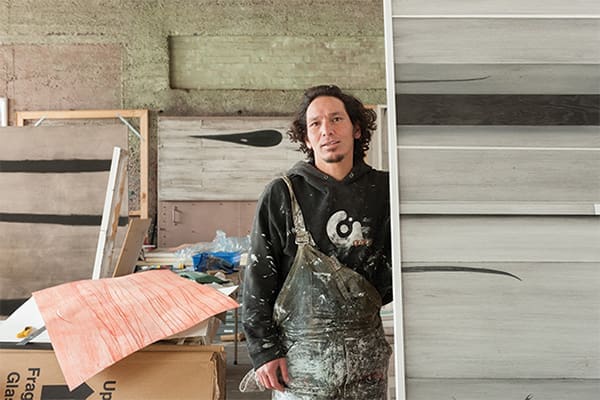
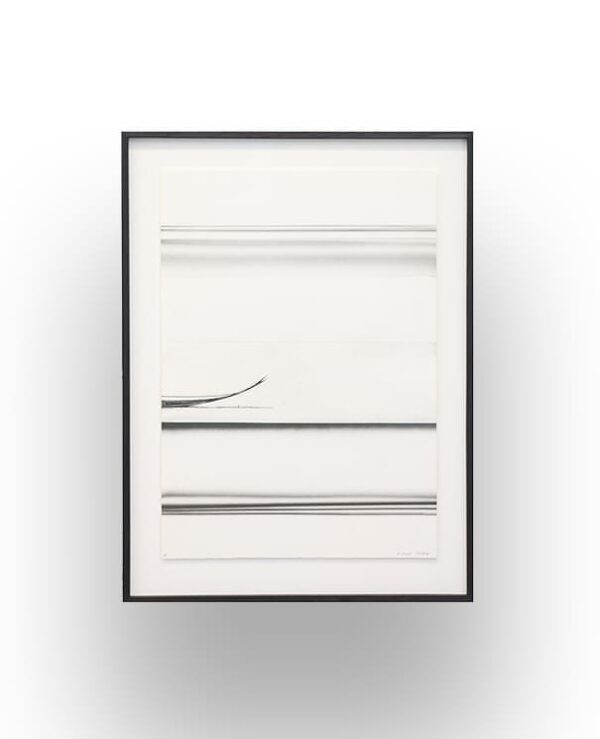
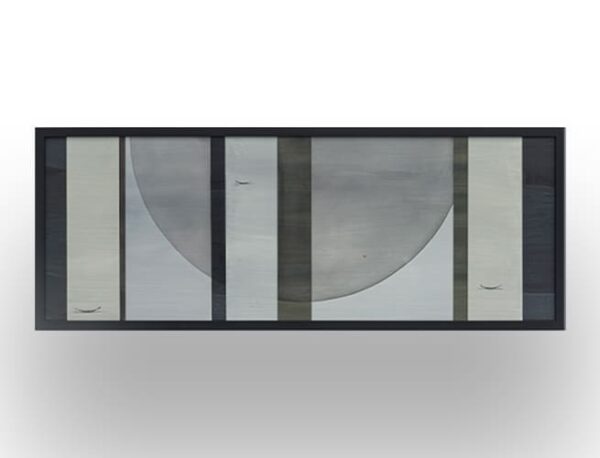
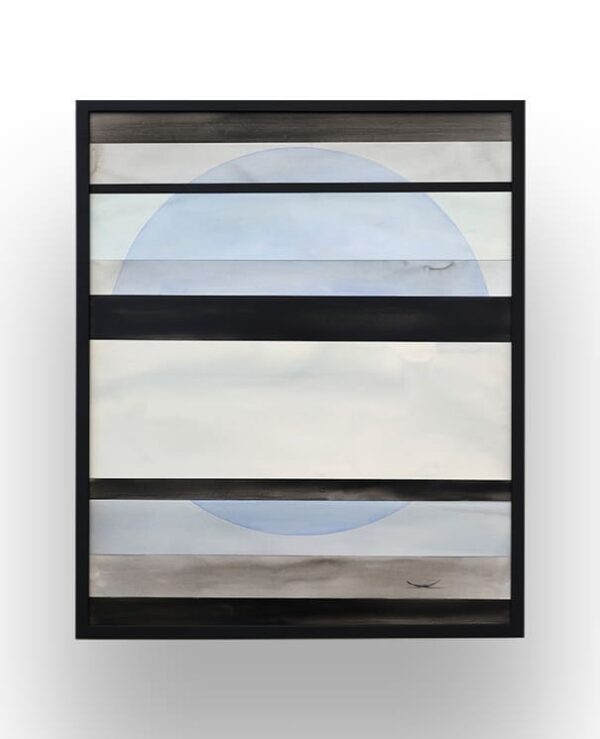

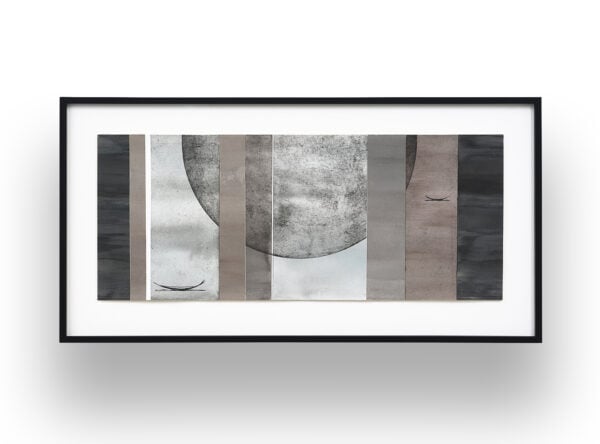
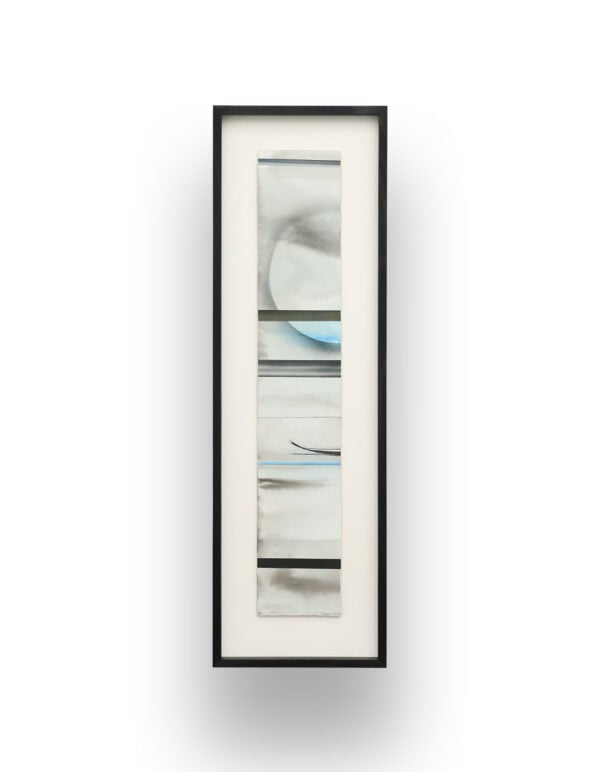
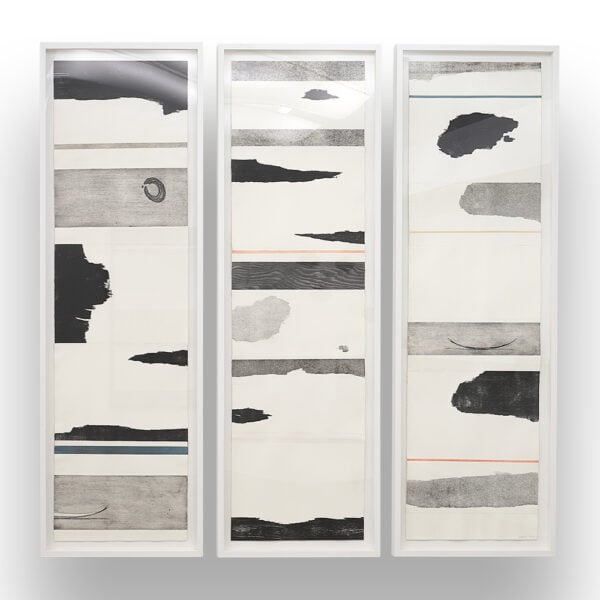
There has been much written about Simon Kaan’s beautifully articulated printed and painted scapes.
His soft focus, tranquil palette and finely stacked horizons, peppered with highly emotive and delicately rendered symbols and icons, have become a well-known and much-loved addition to the New Zealand art canon. But there is also a sense that there is something undisclosed, the strands of other more heavily loaded ideas lurking just below the surface of his serene visions of land and sea.
Simon’s work has previously been described as “contemporary and timeless,” a notion that seems to fit well with many of the indigenous relationships referenced in his artmaking. It was during our first meeting that issues of time and duration came to the fore. I suggested that his practice was somewhat of a slow burn – teased out over many years. He agreed, commenting that his visual language was something he had continued to refine over his career, with what appeared to be only small movements in direction and theme. This invested approach to exploring a series of subtly different variations works in opposition to the fast paced and highly competitive nature of the current art scene. Exploring a subject in depth feels more akin to the practices of many of our senior artists who have taken years and decades to fully extrapolate an idea, rather than that of a mid-career artist with so many diverse interests. This is because many people are not so familiar with these other facets of Simon’s artmaking and life – as a printmaker, painter, performance artist, curator, spatial designer, surfer and self-confessed foodie.
These various aspects of his life come together in many of the projects that are not so well documented. In preparation for this essay, I read an article on Simon’s practice by Bridie Lonie, that described her participation in a 2010 project at Blue Oyster Project Space called The Asian. Simon set up a series of opportunities for people – friends and strangers, to share a meal with him – they were seated at a table in the gallery while he joined them via Skype from a restaurant across the road. This unusual scenario seems to get to the heart of Kaan’s practice. While his printmaking and painting serves a certain drive to create visual dialogue – it is in fact the act of physically and virtually sharing space and ideas that motivates him.
Simon has investigated some of this fertile ground in other performative projects that bring together community, history and food. Food is often the essence of the way in which individuals, families and communities engage with one another. As The Asian so expertly demonstrated, sharing a meal tends to break down many of the barriers, fears and insecurities, allowing people to engage in conversations that may otherwise become superficial and guarded.
In 2012, Simon and co-collaborator Ron Bull presented Kaihaukai as part of the International Symposium on Electronic Arts, IAIA, in Santa Fe, New Mexico. The intention was to work with local indigenous communities in Santa Fe and Aotearoa to explore the concept of sharing food. This workshop-style activation utilised Skype to make connections across the globe and to discuss the importance of traditional foods and histories. A second iteration a year later in Victoria Square, Christchurch brought together a number of Ngāi Tahu artists to build a more locally-focused dialogue. The location for this particular event was poignant as this space was originally called Market Square, intended by its 19th Century planners as a place to buy, barter and exchange.
Simon’s interest in the significance of sites can also be seen in other recent projects where he has taken on a Māori advisory role in the conceptualisation of various architectural developments at Otago Polytechnic Te Kura Matatini ki Otago in his hometown of Dunedin and the Christchurch Aquatic Centre. These activities feed directly into his role as Deputy Chair of Paemanu: Ngāi Tahu Contemporary Visual arts, a network of Māori artists.
Bringing these advocacy and spatially orientated modes into play has extended Simon’s ability to explore other issues of culture. He talks about ways to access a shared memory bank, which connects us to our tupuna (ancestors) but also very much grounds us in this land and this place. The built structures we use for shelter, and to come together as a community, play an important role in helping us position ourselves and to define the conduits we use to relate to one another.
When I saw Simon’s work for the first time in the late ‘90s, his compositions were fresh and seemed to beautifully articulate the aesthetic sensibilities of his mixed heritage. In the process of writing this essay and learning more about Simon’s practice I have come to understand that his work is more than the prints and paintings I discovered in my 20s. I have a better sense of his underlying motivations and the things that invariably drive all of his artmaking decisions – it is community, time and, more often than not, a shared meal.
Essay by Karl Chitham
Courtesy of Sanderson Contemporary