



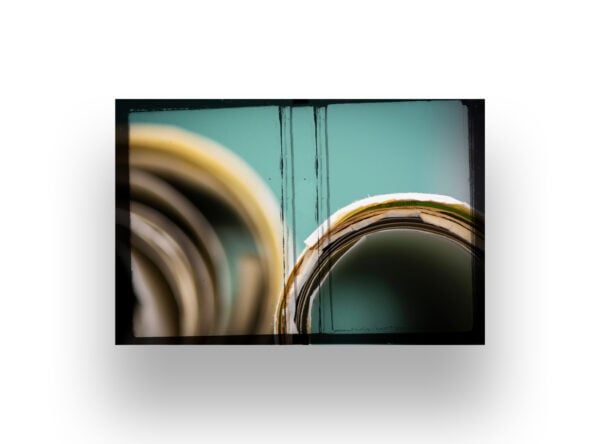
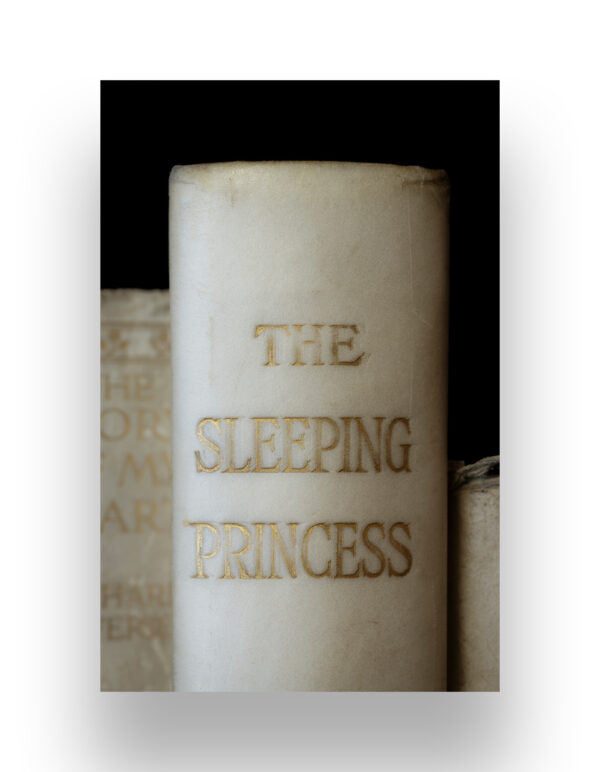


Mickey Smith’s photographs of bound periodicals, combine the technical finish and compositional elegance of portrait photography with the contingency of the snapshot. They are still life’s of objects captured in the wild.
The photographs are striking and ingenious, and they’re also surprisingly compelling in other ways. These are pictures that seem to have something to tell us.
At first, her images read as visual puns, comical ready-mades, moments of Zen—a frayed binding marked TIME, a scarred cover stamped LIFE. Sometimes, the pictures are nearly aphoristic: they seem to speak for themselves. MONEY begets MONEY. The first ENDEAVOR is a failed ENDEAVOUR. TOMORROW forever disappears into TODAY.
NATURE is a colourful, irregular profusion, unlike those rows of grim medical-school soldiers: SPINE, BLOOD, PROBE, CANCER, GUT. In a low-angle shot, begrimed volumes of THE METAL WORKER rise up like skyscrapers. Of DETAIL, we see . . . a detail. INTELLIGENCE comes in different forms, and among the COGNITIONs, a single on-button is lit. This one’s awake! Then there are the extinct species, fossils the artist has pulled from the tar pit of the past: THE LEISURE HOUR, WHO’S WHO IN COLORED AMERICA, WORK WITH BOYS.
Still, the last impression is not one of playfulness. This is partly because of aesthetic choices the artist has made about colour and scale (neither readily appreciated in reproduction). But it’s also because the works resonate with the history of photography. They do something that only photographs can do, and, in doing it, they have something to say about the subject named in the title. They are pictures about the study of words.
The wit in Mickey’s photographs is classic photographic wit. These pictures are records of intersections – whether from chance or design no one can say – between matter and meaning, and this is one of the feats that photography performs. Verbal wit plays with meanings hidden in words and phrases; photographs play with significances hidden in the visual field. In the flux and welter of the world’s stuff, the camera finds temporary pockets of coherence, accidental patterns, fugitive symmetries. A man leaping over a puddle reproduces his own silhouette, perfectly, upside down. Nobody planned it. Before photography was invented, and before there was film fast enough to snatch the image out of the ether, probably nobody would even have seen it.
Not all photographs are serendipitous in this way, but serendipity is the life of photography. Photography’s claim on the fortuitous and the upstaged as art is its claim to distinction as a creative medium. We talk about novels and paintings as “representations”—as copies, or transformations, of real things. Most of the time, this is a fiction. There is no Emma Bovary; there are only the words Flaubert put on a page. But there really was a man jumping over a puddle in the Gare Saint Lazare in 1932. And the books in Smith’s photographs really were on a shelf in a library somewhere. This is something we understand, instinctively, when we look at any photograph—that what we are seeing in it once was. Alive or dead? we ask about the man in the photograph. We don’t ask that about Picasso’s nudes.
One important thing about the images is their found-ness. The photographs are taken from life; they’re not made from props in a studio. The artist was on library safari.
Excerpt from Visits to the Pyramids by Louis Menand
Courtesy of Sanderson Contemporary